

Dealer.gov

Vermont makes a lot of money from its role feeding Vermonters’ addictions. We must reduce our dependence on the promotion and sale of products and behaviors that feed those addictions, even as a modest portion of that money gets invested in addiction prevention and treatment programs, but hardly enough to dissuade our hunger for addictive substances and behaviors.
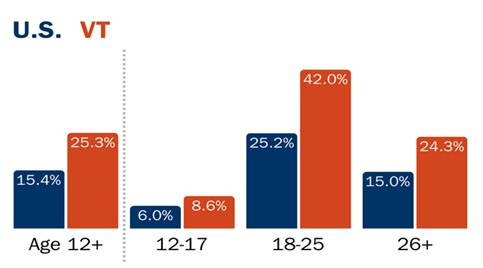
Source: State Level Data National Survey on Drug Use and Health 2022-2023
· Vermont’s past-month cannabis use rates are higher than the U.S. average for all age groups. Meanwhile, Vermont earned $14,576,712 in 2024 on cannabis excise and sales taxes.
· Vermont’s past year prescription opioid misuse is slightly lower than the U.S. average, while heroin use is slightly higher. Vermont’s past year cocaine and meth use rates are higher than the U.S. average.
· Vermont earned $6.3M in revenue from online sports betting in 2024
· In 2024, Vermont earned $3,101,172 wine and liquor sales. More than 60 percent of Vermont residents drink, nearly 20 percent higher than the U.S. average. Vermont ranks in the top 10 states nationally for per capita alcohol consumption, rates of binge drinking and the share of residents thought to have a diagnosable alcohol-use disorder, estimated at about 12 percent of adults — 66,000 people.
· Vermont has the highest healthcare costs in the country according to a peer-reviewed article in the Journal of Consumer Affairs. Vermont has the highest healthcare insurance costs in the country.
· 17.1% of Vermont children ages 0-17 have experienced two or more adverse childhood experiences.
How a government understands and manages addictive substances and the human and societal damage from addictive disorders is a powerful signal about the mission of a government to advance the well-being of its citizens.
Governments intersect with addiction in four ways:
1. statutory regulation
2. law enforcement
3. “sin” taxation/revenue generation and
4. their investments in prevention, education, and addiction-recovery programs.
Governments are quick to regulate and tax, but often struggle with the law enforcement and criminal justice side, and too often, ignore investments in addiction recovery. It’s too easy to just implement regulation and taxation as a new revenue source for their other priorities.
Government’s lucrative relationship with addictive substances extends back to the early 1800s when the British East India Company grew and harvested opium in India to be sold in China, addicting an entire population and leading to the Opium Wars.
Since then, state and federal governments have tried with little success to regulate addictive substances and behaviors. The Volstead Act sought to end alcoholism by illegalizing the brewing or sale of alcohol but federal “revenuers” could never put an end to the burgeoning homebrew industry. My Morrisville uncle, Mandoza Couture, remembered relatives running pot liquor from Canada in the ‘30s on Lake Champlain.
Admitting defeat in 1932, the federal government reversed course, repealed the Act, and decided to simply regulate the sale of liquor, deriving income through taxation. This model seems to have won out for other addictions as well.
Like Reagan’s 1986 “War on Drugs” and Nixon’s earlier 1971 effort, simply prohibiting addictive substances has been an accelerating failure.
In a conversation with Nora Volkow, Director of the National Institute on Drug Abuse, Dr. Volkow explained to me that addiction is a psychological and/or physiological dependency on chemicals either introduced into the body (alcohol, tobacco, drugs, sugar/refined carbs) or generated by certain behaviors such as exercise, hypersexuality, or gambling that stimulate the body to produce chemicals on which the psyche becomes dependent, like endorphins, dopamine, or adrenalin.
Substance addictions warranting regulation and treatment are alcohol, pharmaceutical and street drugs, tobacco and cannabis, and sugar and refined carbohydrates (ultra-processed foods (UPFS) or “junk food”). Physiological addictions warranting serious attention are gambling and hypersexuality and eating disorders such as anorexia, bulimia.
Vermont’s Title 18 addresses the possession and control of regulated drugs and tries to differentiate between street and pharmaceutical distribution but, I would argue, fails catastrophically, as we’ve seen in the Purdue/Sackler/ Johnson & Johnson scandals, among others. At the enforcement level, “Doctor Feelgood” is usually treated differently from the street-level cocaine dealer.
Recent scientific research flies in the face of the liquor industry’s mantra that a glass or two of red wine a day is good for heart health. According to the CDC and many other sources, alcohol use at any level is deleterious to one’s health.
It is also reported to increase the risk of certain cancers.
Alcoholics Anonymous and residential treatment programs have been effective at treating those who acknowledge their addiction, but there are far too few recovery beds in the few residential programs in Vermont to deal with the volume of alcoholics seeking recovery.
Vermont’s Alcoholic Beverage Tax assesses a 10% tax on the serving of alcoholic beverages. How much of the revenue that produces is used for treatment of alcoholism, especially when Vermont once led the nation in underage drinking? I have not been able to answer this question.
As many as 10 million Americans live with a gambling addiction. The act of gambling itself is legal in most jurisdictions. 33 states have now legalized online sports betting, including 24 jurisdictions that allow online betting, which often makes it easier for people to rationalize risky gambling behaviors. Most people who have a gambling addiction don’t see it as a problem, however. For example, only 21 percent of incarcerated individuals diagnosed with a gambling addiction ever thought their gambling was a problem.
Betway is the largest online gambling firm in the world, with revenues of $1.4B and profits of $255.6M. Here is their stated commitment to remediating the addiction they enable and profit from: “In 2020 and 2021, Betway’s charity contributions reached over £300,000 ($370,000). Those donations included Gamble Aware, Trust, Bet Blocker, Red Card, Gambling Therapy and BetKnowMore.” Let’s note that $370,000 is less than one and a half of one percent of profits (.0014%).
Meanwhile, what we all have known has now made headline news, “The NBA gambling scandal that exploded last week came with a twist: The bets were placed using legal apps, made using information that prosecutors say the bettors obtained illegally.”
Over the last 20 years, the U.S. has been quite effective at reducing tobacco addiction through education and punitive taxation, although the marketing of vaping products has spawned a new threat to our young people. The Vermont legislature recently passed S.18, to “ban the retail sale of flavored cigarettes, e-cigarettes, and e-liquids effective January 1, 2025.” But Governor Scott vetoed the bill in April. … Dealer.gov?
Another bill tied to addiction that’s adrift in the Legislature is H.372 / S.125: “This bill proposes to repeal the prostitution laws that currently prohibit ‘indiscriminate sexual intercourse’ and consensual engagement in sex work for hire by adults while retaining strict prohibitions and felony criminal penalties for human trafficking of persons who are compelled through force, fraud, or coercion to engage in sex work.”
Vermont is not immune to human trafficking. Since its inception the Vermont Human Trafficking Hotline (1-888-984-8626) has identified 96 cases of human trafficking in Vermont; 156 victims were identified in these cases.
Turning to perhaps the most prevalent addiction -- according to the NIH in a recent test using the most modern definition of obesity, 68.6% of those tested were climatically obese.” Here in Vermont: “Some 60% of Vermonters are clinically obese. Although evidence suggests that taxing sugar-sweetened beverages (SSBs) is an effective way to reduce obesity, Vermont tried and failed in 2014-2016 to pass an SSB tax as the effort was foiled by opposition from the beverage industry.
Americans consume on average 60 pounds of sugar a year – mostly from high-fructose corn syrup. Look at a five-pound bag of sugar and imagine eating it in 30 days. Try to find sugar-free tomato sauce, crackers, or soups in the grocery store. Common ketchup is 28% corn syrup. Mexican drug cartels put heroin in candy to get young people addicted. How is adding sugar to everything any different?
At the peak of my own food addiction, I weighed just shy of 500 pounds and had to weigh myself on a grain scale at the local Agway to record my actual weight before entering an addiction treatment facility that treated eating disorders.
In desperation, after years of trying to lose weight and failing, I signed into a 30-day addiction treatment facility and began to understand the genesis of my addiction. By abstaining from refined carbohydrates – sugar, flour, and wheat – I was able to lose some 240 pounds safely over the course of two years. The first few weeks were hard, but, in time, the compulsion to keep eating subsided with abstinence, as it can in recovery from alcohol, tobacco, and opioid abuse.
Meanwhile, the $75B diet industry has a 90% failure rate, as most weight lost is soon regained.
In framing a coherent health policy for Vermont, we must understand and tally deaths from the full range of addictions. A death by drug overdose is horrendous, but so are deaths resulting from morbid obesity, smoking, and alcohol or from the personal or family tragedies of gambling or human trafficking. Each must be accounted for in the annals of morbidity and mortality and public policy must take all into account. But these figures are not available.
While it’s imperative to focus on reducing deaths from drug and alcohol overdoses, we’re shortsighted if we don’t acknowledge and tally the devastating effects of all substance and behavioral addictions on Vermonters and stop profiting from them.
(continued) ability to survive famines by gaining weight in good times . Now that is a liability. Darwin's "survival of the fittest" was in part "survival of the FATTEST" ‼️
🙊 🗣️ Speaking of food 🥑🥝 addiction, up until 100 years ago human natural selection favoredthe